
The storm that takes a tree down in Burke is usually on the forecast two or three days before it arrives. Those days are the most useful ones an owner gets, and most people spend them doing nothing about the trees at all. What follows is the pre-storm routine a careful owner in Burke can run in an afternoon, built around what Fairfax County and the utilities actually say, so that if a tree does come down the next steps are already known rather than looked up by flashlight.

Walk the lot the way a crew would
Start outside, with the forecast wind direction in mind, and look at each large tree from the side the wind will hit. The questions are simple. Which limbs hang over the roof, the driveway or the neighbour's house? Which trees have dead wood in the crown, the grey, bark-less branches that fail first in any wind? Which trunks lean, and has the lean changed since spring? Is there a service line from the street to the house passing through any canopy? A crew that does this for a living will say the same thing: the trees that fail in Burke storms are rarely surprises, and dead wood that could have been taken out on a calm day is the most common reason a roof gets hit. How that work is done, and which branches come out first, is described in a separate piece on removing dead wood from the canopy.
Know the lines before the wind does
Fairfax County's own guidance for trees and wires is blunt: never touch a downed wire or a tree in contact with one. Dominion Energy takes those reports at 1-866-366-4357, and NOVEC customers in the western part of the county have their own number. The practical pre-storm step is to find out, now, which of the two serves the house and to put the number where everyone in the household can see it, because the outage that follows a storm is also the moment the phone's battery is lowest. The same walk should note whether the line from the pole to the house runs through a tree, since a limb on that line is a utility call first and a tree call second, and no crew will cut a tree that is touching an energised line.
Clear the drop zone
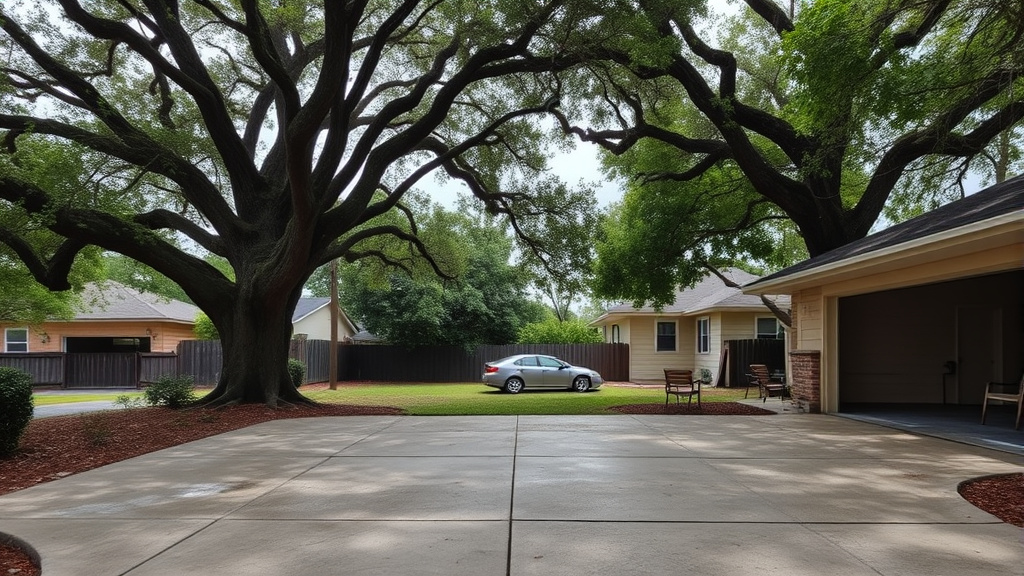
Every large tree has an area beneath it where a failing limb will land, and in Burke's tighter subdivisions that area is usually the driveway. The cars, the grill, the trampoline and the patio furniture that sit there on an ordinary day are the things that get crushed in a storm, and moving them takes ten minutes. Park on the street side away from the biggest trees if the street allows it, or in the garage. Take the umbrella out of the table. Bring in anything light enough to become airborne, because the wind that breaks a limb will also throw a chair through a window.
Photograph everything, in daylight
The first-hour steps after a tree has come down, including the advice to take pictures before anything is moved, are set out in A Tree Just Came Down in Burke, VA: The First Hour, Step by Step. The pre-storm version is just as valuable and almost nobody does it: photographs of the trees, the roof, the fence and the cars, dated and taken in good light, before the storm. An insurer deciding whether a tree was healthy or already dead when it fell, or whether a fence was standing the day before, has only the owner's evidence to go on, and the before pictures are the half of that evidence most owners never have.
Learn the county's map of who does what
Fairfax County publishes a single who-to-call page for trees, and it sorts a Burke storm into a handful of phone numbers. A tree on a house, or any immediate threat to life, is a 911 call first and the insurer second. A tree blocking a public road is also 911; the county is explicit that a fallen tree is not treated as hazardous unless it blocks a street or road. A tree down on a VDOT-maintained road goes to 1-800-FOR-ROAD or VDOT's online form, and county-maintained roads go to Maintenance and Stormwater Management at 703-877-2800. A tree in county parkland, which borders many Burke lots along the streams and the Burke Centre paths, is the Park Authority's at 703-324-8594. A tree on private property is the owner's, and the county will only step in when it threatens the public at large; a dispute with a neighbour over a dangerous tree is, in the county's words, a civil issue in which it will not act. A tree on school grounds goes to the schools' facility management at 703-764-3500. Knowing which of these applies to each tree around the house, before the storm, saves the one hour that matters most afterwards.
Line up the crew before you need it
Emergency tree work is priced on access, hour and risk rather than on the size of the tree, and the owner who already has a company's number, has had an arborist on the lot and has a written assessment of the trees is in a different position from the one calling six companies at midnight. The assessment itself is often free, and it tells the owner which trees are worth pre-emptive work and which can be left. What to look for in that company, from certification to insurance to whether the same crew does the assessment and the work, is covered in a guide to choosing the crew.
The crew Burke calls
G&V Tree Service, a family-owned company based in Springfield since 2001, handles storm emergencies across Burke and the rest of Fairfax County. Every crew it sends out is led by ISA certified arborists trained to ANSI A300 standards; the company is a member of the Tree Care Industry Association and the International Society of Arboriculture, it is licensed to practise tree care in Virginia and insured specifically for tree work, and it does not subcontract, so the arborist who assesses the trees before the storm is the one whose crew comes after it. On-site estimates are free.
Abiding Presence on Lee Chapel Road to the Springfield office
Abiding Presence Lutheran Church at 6304 Lee Chapel Road sits on the southern side of Burke; the G&V Tree Service office on Brandon Avenue in Springfield is a short drive east by way of Old Keene Mill Road, mapped below.
G&V Tree Service Inc · 6434 Brandon Ave, Suite 204, Springfield, VA 22150 · (703) 569-2570
Questions Burke owners ask before a storm
Should I have a tree taken down just because a storm is coming? Only if an arborist's assessment says it is a hazard. A sound tree with dead wood removed is far more likely to stand than to fall.
A limb is resting on the line from the pole to my house. Who do I call? The utility, not a tree crew. Dominion takes those reports at 1-866-366-4357, and the county's rule is never to touch a tree in contact with a wire.
If a tree falls in my yard and hits nothing, is that an emergency? Not in the county's eyes. A fallen tree that blocks no road and threatens no one is the owner's cleanup, on the owner's schedule.